If you’ve ever found yourself wondering about the best way to make a metal or plastic part, you’ve likely encountered the terms “CNC turning” and “CNC milling.” Both CNC turning and milling are essential, common methods in today’s factories. However, they operate on completely different principles. Picking the correct one doesn’t only impact your budget. Your choice influences the final shape of your part, what it can do and the speed of production.
Think of it like this. CNC turning is about symmetry and rotation, while CNC milling is about versatility and carving. Let’s break down what that means for your project.
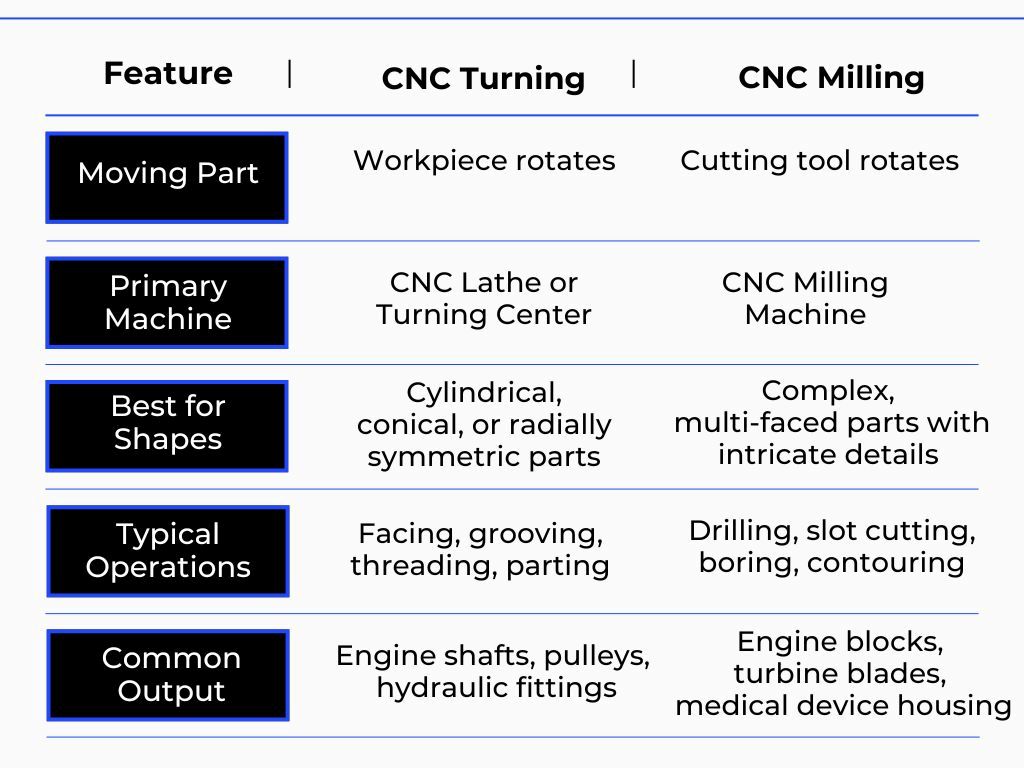
In CNC turning, the workpiece spins. A block of material (called a blank) is secured in a chuck and rotated at high speed. A stationary cutting tool is then carefully moved against the spinning material to shave away layers, creating a cylindrical shape. This is the process you’d use for anything round or tubular, like shafts, pins, bushings or nozzles.
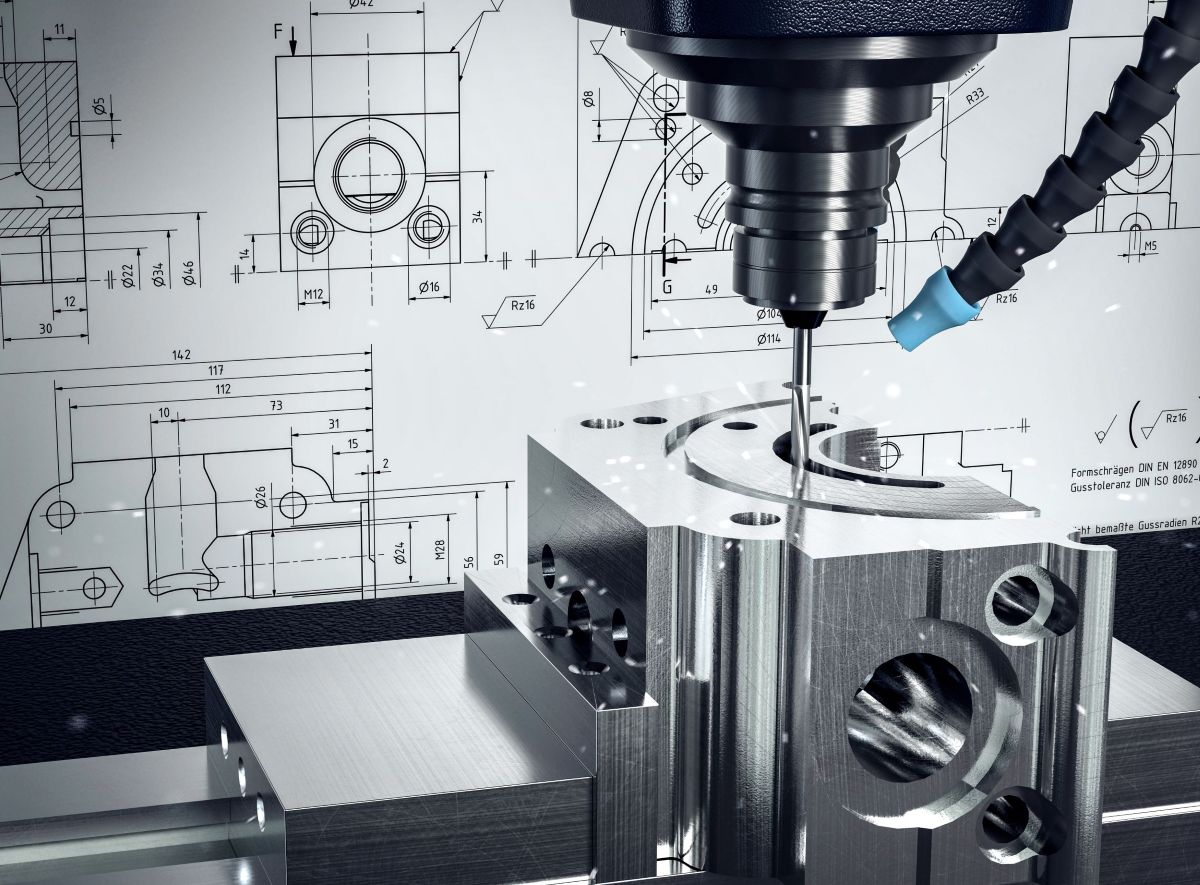
In CNC milling, the cutting tool spins. Here, the workpiece is held firmly in place on a table. A rotating cutting tool – like an end mill or drill – moves across it along multiple axes, carving away material to create shapes, slots, holes and complex surfaces.
When to Choose CNC Turning
Choose CNC turning when your part design is defined by its roundness. If you can imagine it being created on a potter’s wheel, a lathe is your machine. The process excels at producing parts with excellent concentricity and smooth finishes on their outer diameters.
Ideal parts for CNC turning include:
- Rods and shafts: Any long, cylindrical component.
- Bolts and fasteners: Where threads and consistent diameters are needed.
- Ball joints and connectors: Common in automotive and fluid systems.
- Flanges and bushings: Used for mounting and reducing friction.
A major benefit of CNC turning is how fast and affordable it is for creating round components. Because the material rotates continuously, the cutting tool can remove material quickly and consistently. This makes it a great choice for larger production runs.
When to Choose CNC Milling
Choose CNC milling when your part is blocky, geometric or has complex features on multiple sides. It is the go-to process for creating parts that wouldn’t look out of place in an engine bay, a flight console or a surgical room.
Ideal parts for CNC milling include:
- Mounting brackets and plates: With multiple drilled and tapped holes.
- Enclosures and housings: Like those for electronics or medical devices.
- Molds and dies: For injection molding or stamping operations.
- Parts with complex 3D contours: Such as prosthetic limbs or aerospace components.
Milling machines offer incredible flexibility through multi-axis movement. A 3-axis machine moves in the standard X, Y and Z directions, while 4-axis and 5-axis machines can rotate the workpiece or the tool, allowing you to machine incredibly complex geometries without having to reposition the part manually.
Can They Work Together?
Absolutely. The most sophisticated parts often require both processes. A common workflow might involve CNC turning to create a basic cylindrical form and then moving the part to a CNC mill to add cross-holes, flats or keyways.
To save time and reduce handling errors, many shops use CNC turn-mill centers or Swiss-type lathes. These machines perform both turning and milling, so a part can be finished all at once without being moved to a different machine.
Making the Right Choice for Your Project
At Auglaize Erie Machine, we guide you through this decision every day. Here are the main questions we ask to point you in the right direction:
- What is the primary shape? Is it round like a dowel or blocky like a bracket?
- What are the key features? Are they external grooves and threads or internal cavities and pockets on various faces?
- What is your production volume? Turning is often faster for high-volume cylindrical parts, while milling’s setup can be justified for complex prototypes or lower volumes.
- What material are you using? Both processes handle metals, plastics and composites, but the specific material can influence tool choice and machine parameters.
Let’s Talk About Your Project
Still unsure which path is best for your component? That’s what we’re here for. At Auglaize Erie Machine, we solve manufacturing puzzles. Bring us your drawings, your ideas or even a sample part. Our team will work with you to analyze the design, recommend the most effective and economical process and deliver parts that meet your exact needs.
Contact us today for a consultation. Let’s make your idea a reality.